For a solo operator or a small team, a webinar funnel puts about 22% of registrants in the room, and a quarter of that room leaves before the offer. A video funnel drops the appointment: everyone who answers the quiz gets a video edited from their own answers.
Out of 100 registrations, how many hear the pitch?
You promote for three weeks. Two hundred registrations, a clean landing page, three reminder emails. At 2:03pm, forty-four people are in the room. At 2:50, when you finally open enrollment, about thirty are still watching. Nothing went wrong. That is the average.
The attendance range everyone quotes, 35 to 45%, describes nobody your size. It comes from vendor reports measuring marketing teams at established companies, mailing an opt-in list they spent years building. The number that fits you exists, and it is harsher. Banzai and Demio’s Webinar Statistics 2024, built on more than 800,000 webinars hosted in 2023, breaks attendance down by the host company’s revenue: 22% under $1M, 41% between $1M and $10M, 46 to 48% above that. Same platform, same year, same metric.
That cut says something webinar guides tend to skip. Your show-up rate is not a software problem, and not a reminder-sequence problem either, since every host in that dataset runs the same reminders. It is a relationship problem. The colder your list, the emptier your room. The same report puts education services at the bottom of its industry ranking, at 20% attendance.
Say you beat your cohort. Take the friendliest benchmark available: Goldcast’s 2026 report, covering 26,190 B2B webinars run in 2025, lands on a 40% attendance rate, 251 registrants and 102 attendees per event. Even there, the room shrinks a second time. Live attendees finish 74% of a session on average, and Goldcast draws the obvious conclusion: put the call to action in the first two thirds, because a quarter of the audience never sees the last quarter.
Then there is the safety net, the promise that the replay goes out to everyone who registered. It catches almost no one. In the same dataset, 2.62% of registrants watch the recording without attending live. Two or three people in a hundred.
Run the full math on a hundred registrations for a small operator: 22 people in the room, 16 still there when the offer lands, 3 who find the replay. Nineteen out of a hundred heard the whole pitch, and those hundred registrations are already what survived your ad spend and your registration page. One caveat, stated rather than buried: attendance comes from an all-sizes panel and completion from a B2B one, so the chain is assembled from two samples. No vendor publishes the whole chain for an audience like yours, which is exactly the problem.
What the webinar still does better than anything else
Give it credit where it earns it. Nothing beats hearing objections live. An hour of chat and Q&A teaches you more about your market than three months of analytics: where people check out, which words they use, what actually stalls them on price.
Urgency works too. A cart that opens during the session and closes Sunday night produces decisions nothing else produces. And for an offer you have never sold, a room of fifty people is still the fastest test in existence.
Those advantages carry a structural cost: they only exist during the hour you are on air. ON24 recommends on its own blog that you allow around eight weeks to take a webinar from idea to broadcast. Eight weeks for one hour. Next month you start over, with the same 22% and the same room emptying in the final quarter. A webinar does not compound. It reruns.
Automated webinars promise a way out of that loop. They get halfway. You gain always-on delivery and you lose the live element, which was the advantage in the first place. There is still a slot to pick, a countdown, and a canned chat that experienced buyers spot in thirty seconds. On the review page of one of these tools, a therapist describes it plainly: she closes the tab the moment she realizes the live session is a recording, and unsubscribes on her way out.
So the question narrows. Can you keep what the webinar does well, a long pitch people watch to the end, without paying for the appointment?
Seven criteria, side by side
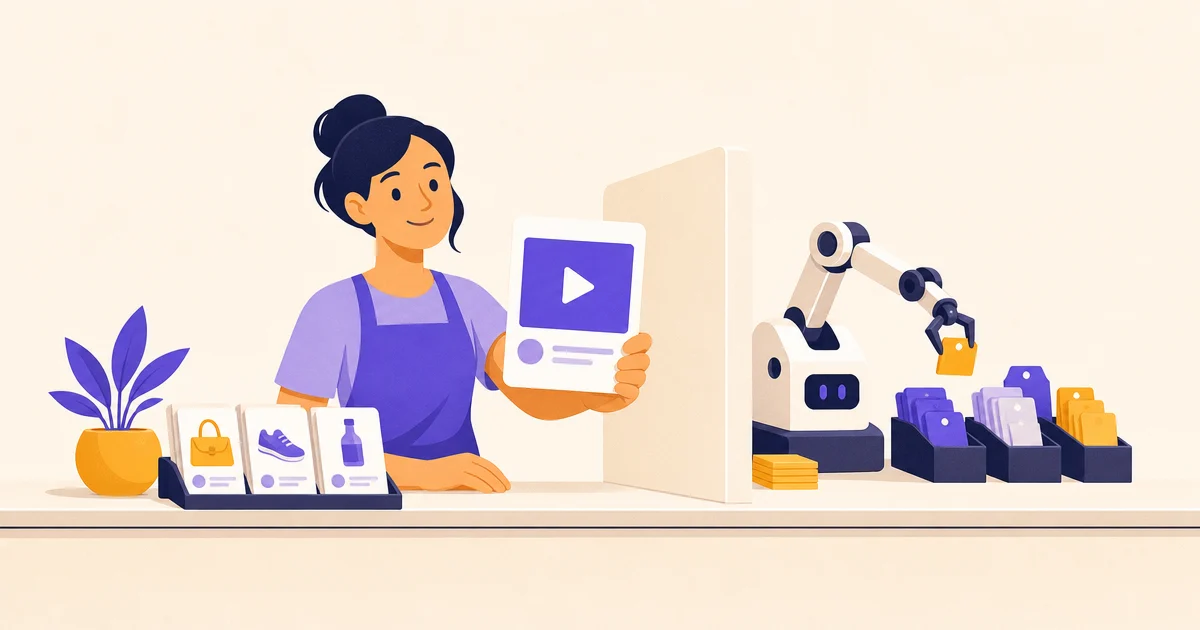
Both mechanisms do the same job: get a stranger to listen to a long pitch before deciding. They go about it in opposite ways. One gathers everybody in the same place at the same hour and plays the same tape. The other waits for a raised hand, asks questions, then sends that person their own version.
| Criterion | Webinar funnel | Video funnel |
|---|---|---|
| Appointment to keep | Yes, a date and a time | None, on demand |
| Share of registrants served | 22% live for small hosts (Demio, 2023) | Every respondent gets a video |
| Delay between click and pitch | A few days to three weeks | Around two hours |
| Length of the pitch | 57 minutes on average (Goldcast, 2025) | 10 to 15 minutes |
| What gets played | The same thing for everyone | Cut from each person’s answers |
| Seller availability | Every session | One shoot, 2 to 4 hours |
| What you learn about the buyer | What they clicked during the session | Their answers, before the video |
The row that decides everything is not length, it is the appointment. The rest follows from it: the drop between signing up and showing up, the three reminder emails, the time zones your buyers live in, the fear of missing out that pushes you to promise a replay, and the replay that empties the live room. Take the slot away and the whole cascade goes with it.
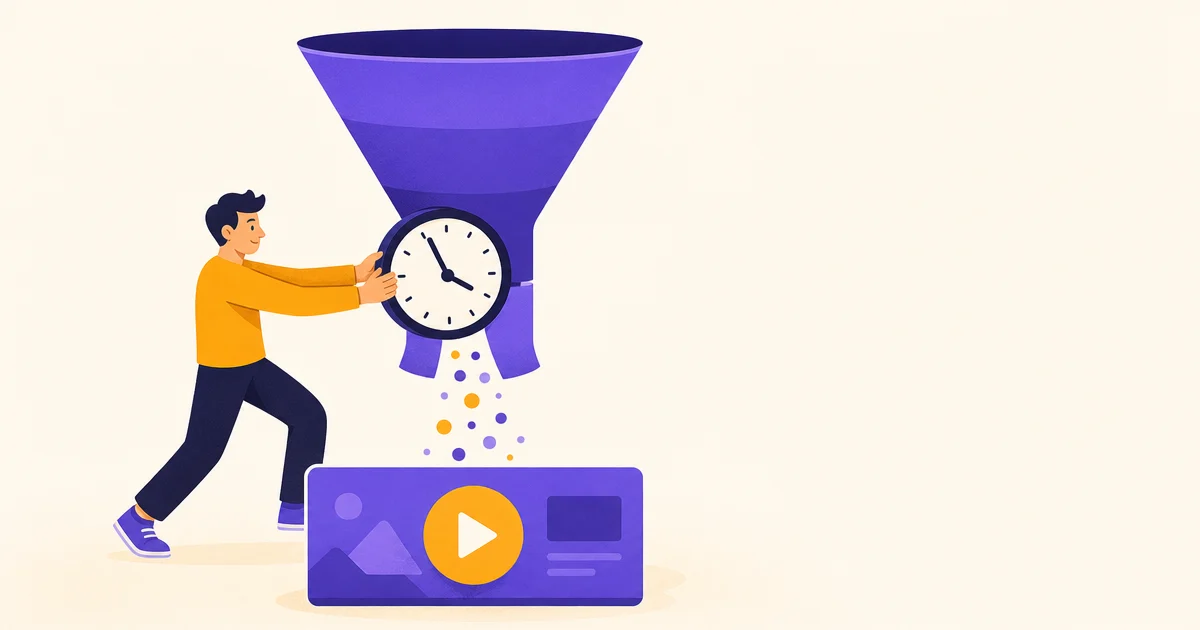
Watch the delay row too. Between the click on your ad and the moment someone actually hears your pitch, a webinar funnel makes them wait days. Buying intent does not wait.
What a video funnel does instead
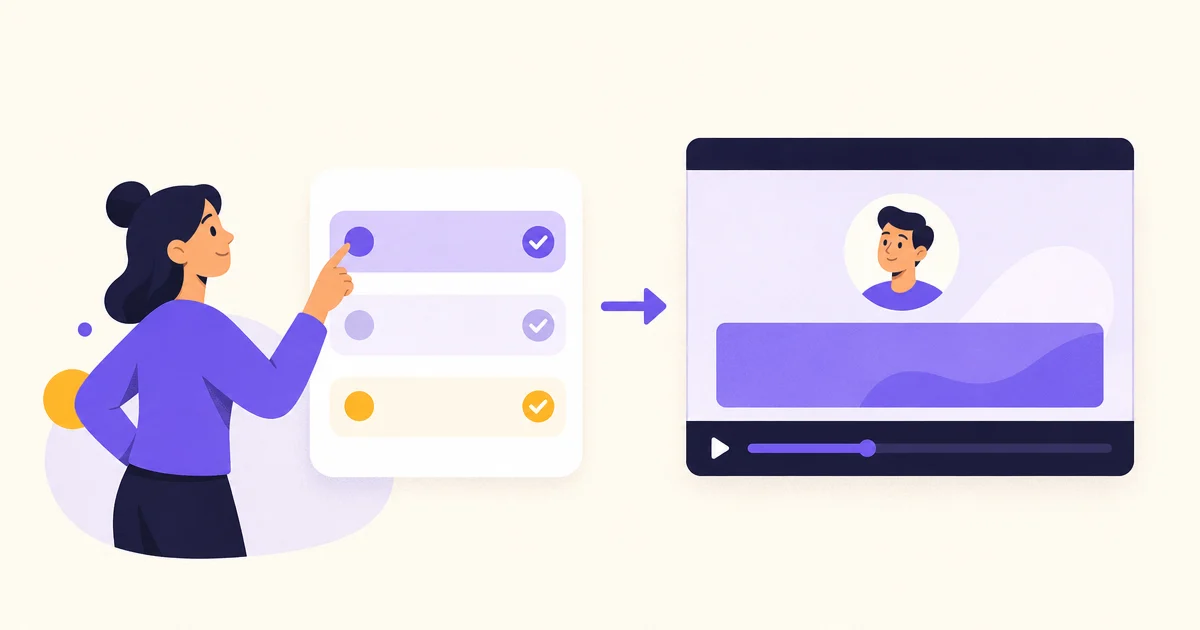
A video funnel swaps the group session for a one-to-one sequence. The visitor answers a quiz of five to fifteen questions, each asked on camera by the seller. Those answers drive the edit: real filmed segments are assembled into a ten to fifteen minute analysis video and sent shortly after, within about two hours in the case VideoFunnel shows.
Nothing is generated. It is your footage, your face, your voice, filmed once. Two to four hours of shooting covers roughly twenty segments, and a funnel with five questions and three options each pulls hundreds of combinations out of them. You shoot one afternoon, then the funnel runs your pitch on demand, tailored per person, for months.
Length matters more than people think. Wistia analyzed over 13 million videos for its 2026 report: the five to thirty minute band is where conversion happens, averaging a 9% click-through rate, and engagement drops 11% as soon as a video crosses the half-hour line. The average webinar runs 57 minutes. A twelve-minute analysis video sits right in the middle of the useful window.
The quiz is not a toll gate. It is what people accept paying to be treated as individuals. Idomoo’s State of Video Technology study, run by Atomik Research in January 2026 with 2,000 US and UK consumers, found buyers four times more likely to want a personalized video than a generic one. In the same panel, 52% said generic messaging signals that a brand does not respect their time, and close to two thirds said they would hand over information in exchange for a tailored experience.
Three mechanisms fire along the way, and they are what sells. Commitment, because the person invested several minutes of answers before seeing any offer. Reciprocity, because twelve minutes were cut for their situation. Conviction, because they watched a long pitch to the end, willingly, with no slot blocked in their calendar.
Two VideoFunnel clients give a sense of the gap, and these results are theirs rather than an average or a promise. BodyTime, which sells fitness programs, asks fourteen questions and delivers thirteen minutes of video, reporting a conversion rate multiplied by 2.5 on the same traffic and thirteen minutes of attention captured before the offer even appears. Anna Velazia, in jewelry, moved 70% of her ad budget onto her video funnel, now her top acquisition channel, with a ROAS three times higher than her other campaigns. If you want the mechanics before the comparison, they are laid out step by step in What is a video funnel? Definition, mechanics and 2026 data.
Which one fits where you are right now
You have never sold this offer. Run one live session for fifty people. Write down every chat question, every objection, every line that makes people leave. You just wrote the script for your filmed segments, for free. The webinar is an excellent laboratory. It is as a production line that it gets expensive.
You already fill webinars and your show-up rate has flattened. This is the most common case and the most profitable one to fix, because you already have the script, the offer, the objections and the proof. All that is missing is the shoot: two to four hours to turn one monthly hour into a pitch delivered to every single registrant, within the hour they raised their hand.
You sell coaching, consulting, or a program whose value depends on someone’s exact situation. That is where the gap gets widest, because that is where one-size messaging does the most damage. The higher the price and the harder the choice, the more a personalized video pulls ahead.
The benchmark problem nobody mentions
One last thing, and it applies to every comparison you will read on this topic. There is no independent measurement of webinar attendance. Every public number comes from a software vendor, measured on its own customers, published by a company that sells the tool whose performance it is grading. That does not make the numbers wrong, and some samples are enormous with methods properly described. It does mean reading the methodology page before the headline.
Two examples make the point. The 35 to 45% range copied from blog to blog is not tied, on any page we opened, to a named study with a sample and a year. And the reports showing the friendliest rates are measuring marketing teams at established companies. You are not in that sample.
So the only number that decides anything is yours, and it takes five minutes to get. Pull up your last webinar, divide the people still watching when the offer landed by the number who registered, and write that number down. Then ask the question that actually matters: what would the same campaign produce if all hundred registrants received, two hours after answering seven questions, twelve minutes cut for them? You do not need a benchmark to answer that. You need an afternoon with a camera.
Frequently asked questions
What is a normal webinar attendance rate in 2026?
Anywhere from 22 to 48% of registrants, depending on the size of the host, and that spread is not a rounding error. Banzai and Demio’s Webinar Statistics 2024, built on more than 800,000 webinars from 2023, measures 22% attendance for hosts under $1M in revenue against 46 to 48% for hosts above $10M. Goldcast’s 2026 benchmark, drawn from established B2B brands, reports 40%.
Does an automated webinar fix the attendance problem?
It moves it. Always-on delivery removes the multi-week wait, but there is still a slot to pick, a countdown, and a simulated live room that experienced buyers recognize fast. More importantly, the content stays identical for everyone: the person hesitating on price and the person doubting they can keep up watch the same hour of video.
Should you drop webinars entirely for a video funnel?
No, the strongest play is to make them work together. A live session is a laboratory: it hands you the real objections, the words buyers use, the exact moments attention drops. Those become the script for your filmed segments. The video funnel then runs that pitch on demand, for every prospect, with no session to reschedule and no availability required.
How long does it take to get a video funnel live?
Plan two to four hours of filming depending on how granular the analysis is, plus about thirty minutes of setup with onboarding support. A recent smartphone and decent lighting are enough, since being human matters more than being polished. For comparison, ON24 suggests allowing eight weeks between the idea for a webinar and the broadcast.