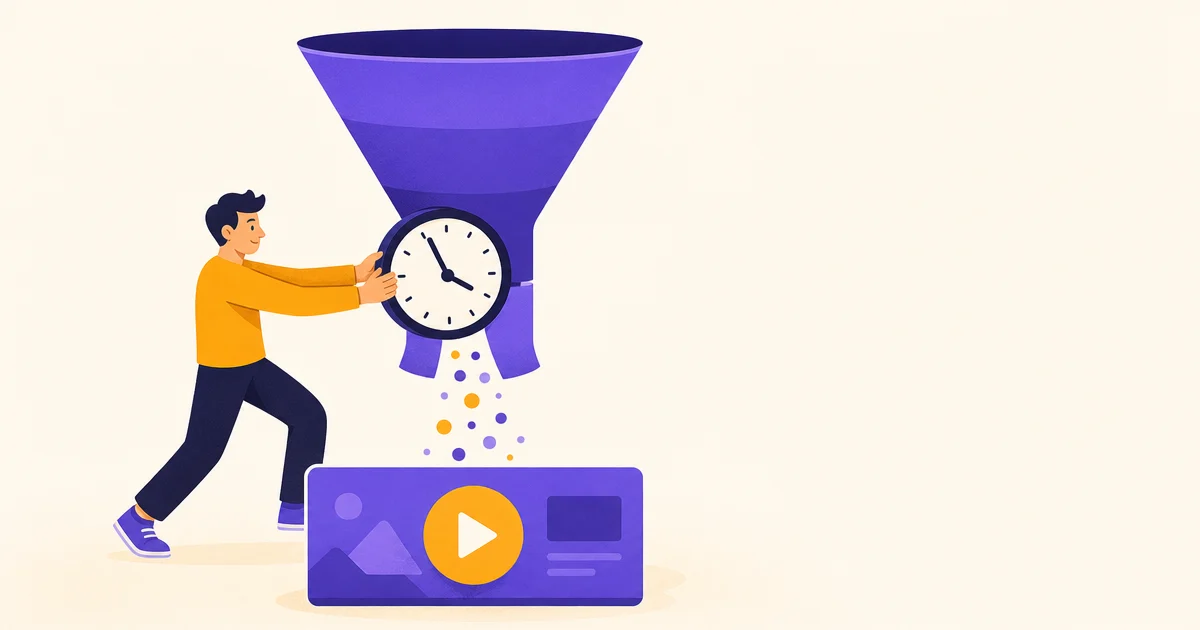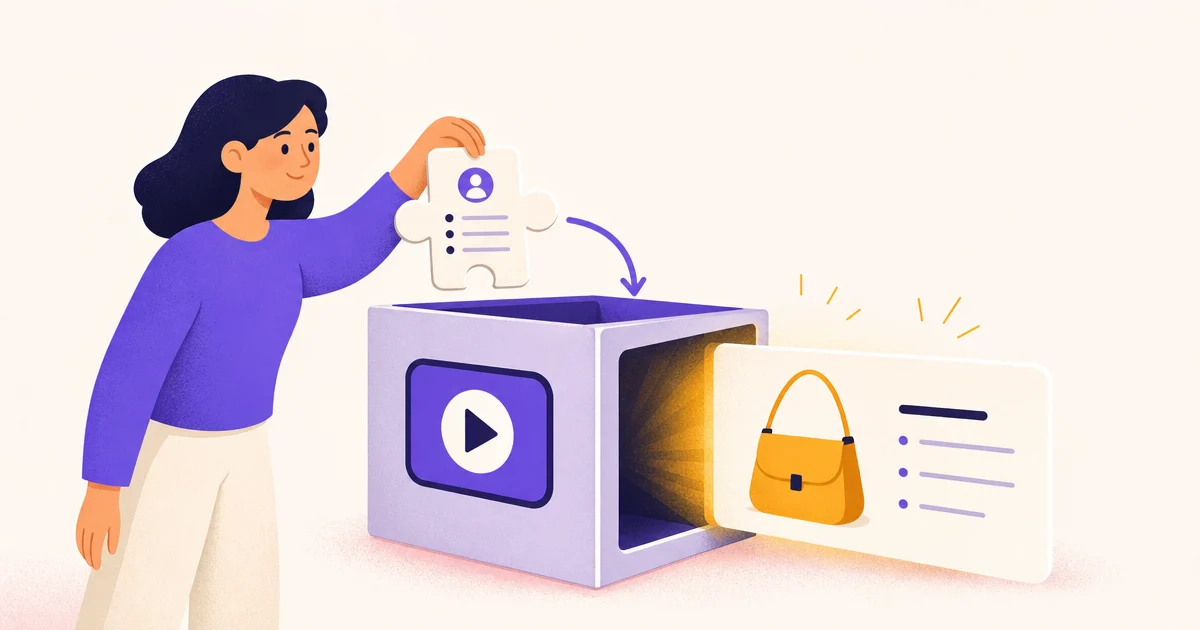

Selling high ticket to an informed buyer means changing jobs. They no longer need information from you. They need someone who will look at their situation and take a position on it. That work starts before the call, in an asset that answers them personally.
What your buyer read before the call
On a Sunday night, a buyer opens a chat with an AI. They type the name of your program, ask what it's worth, request three alternatives, a price range, and the questions they should put to you. Forty minutes later they have a file. Monday morning they book a slot on your calendar, and you still prep the call as if you were about to explain your method.
This is no longer a fringe habit. The Baromètre du numérique, run by Crédoc for the French regulator Arcep in 2026, puts generative AI use at 48% of the population against 20% two years earlier, and notes that in twenty-five years of tracking, no digital technology ever spread that fast. Among those users, 73% use it to look things up. Your offer is one of those things.
On the business side, Gartner surveyed 645 people who had recently completed a purchase. 45% used generative AI along the way, mostly to research vendors and products, and each one consulted seven separate information sources before deciding. Two in three say they would rather move forward without a rep.
Those numbers come from B2B, and that's worth saying out loud. Nobody has published solid research on the 42-year-old who has been circling a $7,000 coaching program for three weeks, and we won't invent the missing figure. The behavior transfers anyway. Your buyers show up quoting your competitors, citing your price tiers, and holding an opinion about your method.
Why the informed buyer still stalls
The same buyer who read everything then asks for a human. In Gartner's May 2026 survey, 69% say they want a sales rep to validate what AI told them. The reason fits on one line: 51% think they're more likely to run into misleading information from generative AI, against 49% who say the same about a rep. The machine produced an opinion. It committed nothing.
Gartner pushes the paradox further in its work on the B2B buying journey. Preference for buying alone is overwhelming, and purchases made entirely through self-service produce far more regret afterward. Gartner also measures that buyers are 1.8 times more likely to complete a high-quality deal when they use a supplier's digital tools alongside a rep rather than working the decision out on their own.
The firm even expects a reversal: by 2030, it predicts 75% of B2B buyers will prefer sales experiences that put humans ahead of AI. Its analysts call it the uncanny valley, the point where an artificial counterpart gets close enough to human to feel wrong. The bigger the check, the more that feeling costs you.
Look at what your buyer actually walked away with, and what they still came to you for.
| What they asked | What AI gave them | What they still want from you |
|---|---|---|
| Does this kind of program work? | A general answer, plausible, true for everyone | Whether it works in their situation |
| What does it usually cost? | A wide range pulled from public pages | What their case actually justifies paying |
| What should I ask on the call? | A checklist of questions | Someone who answers without dodging |
| Could I just do this myself? | An eight-step plan | Confirmation that they'd stick with it |
| Which of the three should I pick? | A balanced comparison | A clear call, owned by a person |
That right-hand column does not get filled with content. It gets filled with a person. One more guide, one more article, one more comparison table will stack on top of what the machine already produced and say the same thing in your brand colors. What your buyer is missing has no written form. They want an identifiable human to look at their case and take a side.
Your PDF, your sales page and your webinar answer a settled question
The PDF lead magnet was built for a reader who knew nothing. It teaches, it frames the problem, it lists seven mistakes to avoid. Your buyer got the same thing in thirty seconds, better summarized, without handing over an email address. The file lands in Downloads with the rest.
The sales page has the same flaw at a larger scale. It says the exact same thing to someone discovering your name and to someone who has been comparing you for three weeks against two competitors and a spreadsheet. It can't do otherwise, because it was written once, for an average. That job, the one your page attempts, an AI just did for this specific person.
The webinar adds a calendar constraint to someone who got their answers at 11pm on a Sunday. Be free Tuesday at 6pm, sit through forty-five minutes before the offer shows up, and absorb a presentation built for the middle of the room. The gap between that format and a video funnel is measured in Webinar funnel vs video funnel: what the attendance numbers really say.
Then there's the classic sales video, recorded once and served to every visitor. It beats text on one point: a face. And it fails on another, which is glaring in 2026, because it speaks to an average profile that doesn't exist. Your buyer spent forty minutes getting a machine to narrow down their case. You greet them with a recording that knows nothing about them.
Every one of these assets shares the same birth defect. They were built before anyone knew who they were talking to.
Answer them in person, before the call
That reasoning leads straight to the video funnel. The buyer answers a quiz of five to fifteen questions, asked on camera by the person selling. Their answers trigger the assembly of genuinely filmed segments into one continuous ten to fifteen minute video, cut for them. It reaches them shortly after, roughly two hours in the use case VideoFunnel shows. The full mechanic is laid out in What is a video funnel? Definition, mechanics and 2026 data.
What they get looks a lot like what Gartner recommends to suppliers without ever naming it: an interactive tool that affirms value, fed by what the buyer declared themselves, returning a recommendation matched to their criteria. Except here the recommendation has a face and a voice. The human validation 69% of buyers ask for arrives before the call instead of during it.
Three forces fire along the way. The buyer invested ten minutes in the quiz, got ten minutes of video back, and watched a full pitch by choice. What those mechanisms owe to social psychology, and why online marketing keeps missing them, is covered in Persuasion principles in marketing: the three forces, and what your funnel does with them.
BodyTime sells training programs. It asks fourteen questions about goals and sends back thirteen minutes of video. The brand reports conversion multiplied by 2.5 on the same traffic, and thirteen minutes of attention captured before the offer even appears. That result belongs to BodyTime. It is not an average and not a promise. The number to keep is the duration: thirteen minutes of voluntary attention, at the exact moment your competitor sends a follow-up email.
The gap widens most when advice weighs on the decision and the buyer cannot judge the answer alone. High ticket meets both conditions by design, because the bigger the sum, the more your buyer wants to be seen before paying.
Five steps and one afternoon of filming
Building this takes less work than most launches. The real effort sits in step one, and it's mental.
- List the five questions that genuinely change your answer, the ones you'd need live to say something different.
- Write one short segment per possible answer. Five questions with three options each are covered by roughly twenty filmed segments.
- Film, in two to four hours depending on how fine the analysis goes. A recent phone and decent light do the job.
- Set the scoring, the delivery and the follow-ups, then connect your CRM. About thirty minutes with onboarding support.
- Move the call to after the video, never before.
Step one is where failed funnels are decided. A useful question is one whose answer changes your diagnosis. Asking for budget qualifies, it personalizes nothing. Asking whether they already tried alone, and for how long, changes everything you say next.
Step five is the one that surprises people. Plenty of sellers drop a video funnel in place of the call to kill the meeting entirely. Keep the meeting and change what happens in it. It stops being discovery and becomes a decision: your buyer has heard your read on their case, arrives with precise questions, and knows the price. You hold fewer of them, and those ones look nothing like before.
An account taking two hundred quiz responses a month sends two hundred different videos, built from twenty segments filmed once. That ratio is what makes the whole thing work. You film once, and the combinatorics do the rest.
"I don't have time to film," and the other objections
The objection always lands in the same spot. Filming twenty segments costs half a day, you have to look presentable, and the camera is intimidating. True. It's also the exact reason your competitors won't do it. They'll write one more sales page instead, which costs the same hours and shows up nowhere.
The second objection is the interesting one. Since AI can do everything, why not hand it the video too, synthetic avatar included. Take the buyer's side of it. They just spent forty minutes with a machine, got decent answers, and still haven't decided. Sending them a second machine in better clothes solves nothing. The value of this video sits entirely in the fact that a person took the time to film those segments for people like them.
That gap won't narrow. Information keeps getting cheaper, faster and more abundant, while the attention of an identifiable human stays the one scarce good in online selling. Your buyer doesn't need another explanation. They need to be looked at. Ten minutes of video cut for them does that work, and it's already sitting in their inbox when they pick up.
Frequently asked questions
Do you still need a sales call to sell high ticket?
Yes, and it still decides the deal. Gartner found that 69% of buyers want a human to validate what AI told them (2026). What changes is the content of the meeting. When your buyer has already received a personalized analysis video, the call stops being a walkthrough of your method and becomes a decision.
How do I know what my buyer already asked an AI?
Ask them, inside the quiz that opens the video funnel. One question about what they've already tried, another about the options they compared, and your video picks up where the machine stopped. It's also the best source of real objections you'll get for writing your next segments.
Would an AI-generated video do the same job?
No, and that's the whole point. A personalized analysis video works because the segments are genuinely filmed by the person selling. Someone who just spent an hour with a machine is looking for a human. VideoFunnel assembles filmed segments, not synthetic avatars.
How long does it take to set up a video funnel?
Two to four hours of filming depending on how detailed the analysis gets, plus around thirty minutes of configuration with onboarding support. Writing the questions and the segments takes the rest, and that's the work that matters: a funnel lives or dies on the questions you ask, not on image quality.